
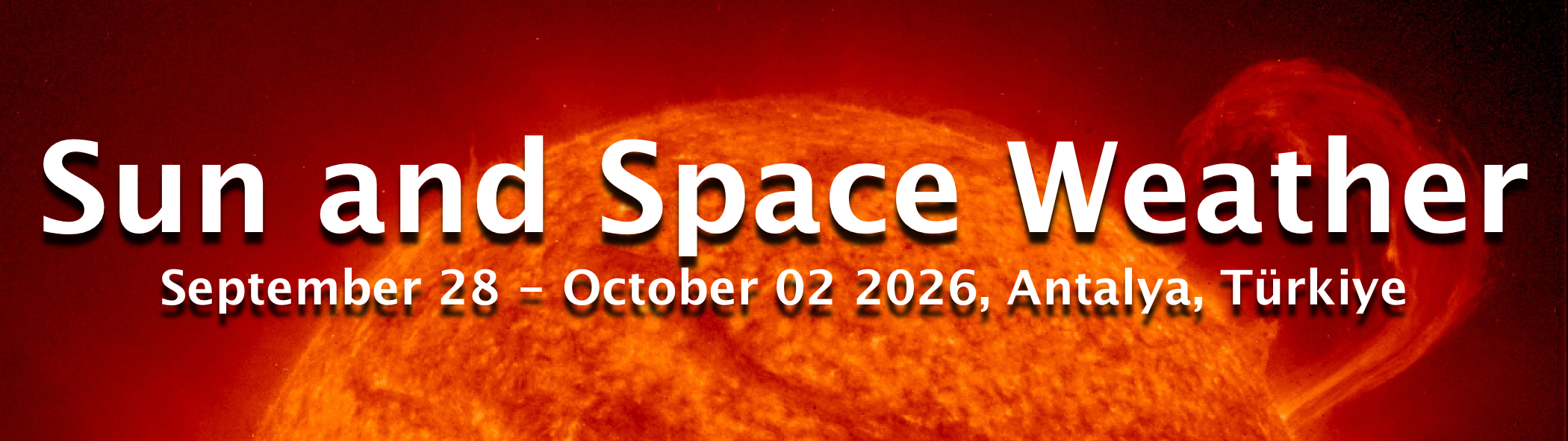
First Workshop on Sun and Space Weather will be held from September 28 to October 02 2026 in Antalya, Türkiye.

Papers and posters presented at the workshop will be published in the conference booklet. Also, selected papers will be forwarded to Sun and Geosphere journal with a recommendation for publication if requested.
The workshop topics will include:
- Cyclic behaviors of solar and geomagnetic activity
This section covers the systematic variations of solar and geomagnetic phenomena, such as 11-year Schwabe cycle and the 22-year Hale cycle, etc. It also includes how these solar variations drive corresponding geomagnetic activity on Earth, including the 27-day periodicity linked to solar rotation and seasonal fluctuations in magnetic disturbances. By highlighting these interconnected cycles, it covers the predictable nature of Sun-Earth interactions and their role in determining long-term trends in space weather.
- Solar and geomagnetic activity prediction
This section investigates the methodologies used to forecast solar and geomagnetic disturbances, focusing on the statistical and physical models that predict sunspot cycle amplitudes and geomagnetic storm occurrences. By evaluating historical data to predict the timing of solar maxima and utilizing real-time solar wind monitoring for short-term forecasting of geomagnetic indices, the field has increasingly integrated Artificial Intelligence (AI) and Machine Learning (ML) to enhance predictive accuracy. These advanced computational techniques, including neural networks and deep learning, allow for the analysis of massive, high-dimensional datasets to identify non-linear patterns that traditional models might miss, significantly improving the lead time for solar flare alerts. By combining these classic forecasting techniques with AI-driven insights, this research addresses the latest developments in early warning systems designed to mitigate the potentially catastrophic impacts of space weather on global technological infrastructure, such as power grids, satellite communications, and GPS networks.
- Eruptive solar phenomena (Flares, CMEs, SEPs, Shocks)
The Sun’s atmosphere is a dynamic laboratory of magnetic reconnection and energy release, culminating in the most powerful eruptive events in the solar system. This session focuses on the fundamental physics governing the initiation, propagation, and inter-relationships of solar flares, Coronal Mass Ejections (CMEs), Solar Energetic Particles (SEPs), and shocks. We invite contributions that explore this eruptive chain, including processes of i) energy storage and release focused on magnetic flux rope formation, pre-flare triggers, and reconnection dynamics; ii) CME evolution from the low corona into the inner heliosphere and the interaction with the ambient solar wind; iii) particle acceleration (flare-site reconnection versus CME-driven shocks); as well as observations and modeling of plasma discontinuities and their contribution to radio bursts and space weather impacts. We especially encourage submissions that utilize multi-wavelength observations (from ground-based facilities to missions like Solar Orbiter, Parker Solar Probe, and SDO) alongside advanced numerical simulations and theoretical models. This session aims to foster a holistic understanding of how these phenomena are coupled and their ultimate influence on the heliospheric environment. Contributions from early-career researchers and interdisciplinary studies are highly encouraged.
- Propagation of CMEs in the Heliosphere
Once a CME is launched, the propelling force continues to push the CME outward until the flare reconnection ends indicated by the end of flare ribbon separation or the expansion of post eruption arcade. Beyond that the aerodynamic drag becomes the dominant force acting on the CME. The CME can also be deflected by the gradient of the magnetic pressure surrounding the CME often due to nearby coronal holes or even active regions. The CME flux rope continues to expand as the heliospheric pressure decreases with heliocentric distance. CMEs are also subject to rotation depending on the distribution of the surrounding solar wind speed. This includes interaction of CMEs with other CMEs resulting in merger or trajectory change. The deflection, expansion, and rotation determine how and when CMEs impact Earth. This session invited papers presenting results on the propagation of CMEs and how their trajectories/Earth arrival are affected by their interaction with the solar wind and other large-scale structures.
- Response of the Magnetosphere to the Impact of CMEs and Stream Interaction Region
The basic solar wind interaction with Earth’s magnetosphere causes the bow shock. Interplanetary magnetic field (IMF) structures riding the solar wind couple to the magnetosphere resulting in the transfer of energy. When the IMF possesses southward component, it reconnects with the Earth’s northward field in the dayside followed by another reconnection on the night side, resulting in the injection of plasma into the magnetosphere that enhances the ring current measured by the variation in the horizontal component of Earth’s magnetic field (geomagnetic storms quantified by the Dst index). The magnetospheric response also varies with latitude. The relevant IMF structures are interplanetary CMEs from solar magnetic regions, stream interaction regions due to high speed solar wind streams originating from coronal holes, and Alfven waves traveling in the solar wind. When a geomagnetic storm happens, Earth’s outer radiation belt is enhanced due to the acceleration of electrons to relativistic energies. The relativistic electrons pose a severe radiation hazard to spacecraft in the magnetosphere. This session invites papers on all aspects of the solar wind – magnetosphere coupling and its geospace consequences.
- Magnetosphere–Ionosphere-Thermosphere coupling
The session focuses on advancing the state-of-the-art understanding of Magnetosphere–Ionosphere–Thermosphere (M–I–T) coupling. It examines how interactions across these regions influence the near-Earth space environment and space weather. This knowledge is essential for mitigating impacts on technologies such as GNSS, radio communications, and low Earth orbit satellites. Improved understanding also supports better prediction of the physical processes driving space weather effects. Research areas include ionospheric electrodynamics, effects of energetic particles and solar flares, and variability across ionosphere and atmospheric layers. Key topics include interhemispheric asymmetries, vertical coupling, and interactions across latitudes. Contributions addressing multiscale coupling processes, energy transfer, plasma structures, ion-neutral interactions, and feedback to the magnetosphere are invited. Both observational approaches, including satellite and ground-based measurements, and modeling studies are emphasized.The session encourages collaboration between researchers and operational communities to address space weather risks. It promotes interdisciplinary studies linking the ionosphere, atmosphere, and magnetosphere.
- Space weather effects on technological systems
Space weather refers to changing conditions on the Sun and in the near-Earth space environment that can influence the performance and reliability of space-borne and ground-based technological systems. Phenomena such as solar flares, coronal mass ejections, and high-speed solar wind streams can significantly impact various systems, including satellites, communication networks, navigation infrastructure, pipelines, and power grids. This session examines the effects of space weather on critical technological systems. As society becomes increasingly dependent on space-based and ground-based systems, understanding and forecasting these effects is critical for resilience and risk mitigation. Topics will include the physical mechanisms of space weather and its propagation through the near-Earth environment, with emphasis on impacts to key technologies. We invite contributions on observational studies, analyses of historical and recent space weather events, modeling approaches, and forecasting techniques. To advance our understanding of space weather, cross-disciplinary and collaborative approaches, combining physics-based and AI methodologies, are welcomed.
Son güncelleme : 29.09.2026 14:24:08